
Key Takeaways
- 1. Choosing the right portable toilet material depends on usage conditions Materials like HDPE, PVC, FRP, and PUF each serve different purposes. HDPE offers durability for heavy-duty use, PVC is suitable for short-term applications, FRP provides long-term strength for demanding environments, and PUF panels are ideal for cold-weather conditions.
- 2. HDPE portable toilets are widely preferred for durability and low maintenance Rotomoulded HDPE toilets provide seamless construction, chemical resistance, weather durability, and safety features like non-slip flooring, making them ideal for construction sites and high-traffic deployments.
- 3. Design quality directly impacts hygiene, comfort, and user experience Features such as proper ventilation, wash basins, plumbing fittings, lighting provisions, anti-slip flooring, and efficient interior layouts help create cleaner, safer, and more user-friendly sanitation facilities.
- 4. Bio toilets offer a sustainable sanitation solution with reduced servicing needs Bio-digester toilets use anaerobic bacteria to break down waste on-site, minimizing odors, reducing waste volume, and lowering the need for frequent pump-out maintenance, especially in remote or long-term installations.
- 5. Regular maintenance is essential for long-term performance and hygiene Proper servicing schedules, chemical treatment management, cleaning routines, and climate-specific maintenance practices are critical to keeping portable toilets functional, sanitary, and durable over time.
Portable toilets have become an essential solution for sanitation across construction sites, public events, industrial zones, temporary workplaces, disaster relief operations, and outdoor gatherings. With rising awareness about hygiene, convenience, and sustainable sanitation, the demand for well-designed portable toilets continues to grow rapidly. Understanding the manufacturing process behind portable toilets helps buyers and businesses choose products that deliver durability, comfort, and long-term value.
As one of the trusted Portable Toilet Manufacturers & Suppliers in Ahmedabad, Siddhi Infra specializes in manufacturing portable toilets that combine strong materials, functional designs, and practical maintenance solutions. The quality of a portable toilet depends heavily on how it is built, what materials are used, and how effectively it can be maintained over time.
For businesses searching for dependable Portable Toilet Manufacturers in Ahmedabad, learning about the complete manufacturing process can make decision-making easier. From selecting robust raw materials to implementing innovative design features, portable toilet production involves careful engineering and practical thinking.
Why the Material Question Is Not as Simple as It Looks
People often treat material selection as a budget question. “Which is cheapest?” That framing misses the point entirely. The right question is: where will this toilet actually be used, for how long, by how many people, and in what conditions? A PVC unit that is perfectly adequate for a three-day outdoor wedding would be a poor choice for a twelve-month highway construction camp with 400 workers rotating through daily. Material selection is a function of context — and getting it wrong costs more in replacement and remediation than the savings on the original purchase price.
HDPE — The Workhorse of the Industry
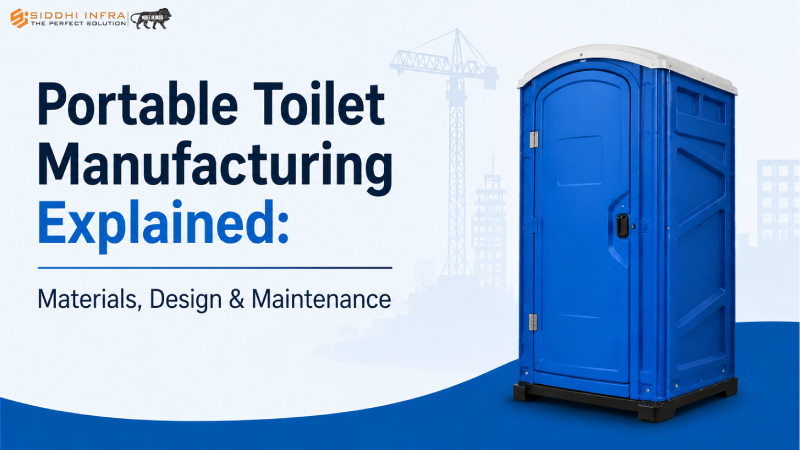
HDPE stands for High-Density Polyethylene. The manufacturing process used for HDPE portable toilets is called rotational moulding — rotomoulding in industry shorthand — and it produces a seamless, hollow structure. No joints, No seams, No weak points where stress concentrates and cracks begin.
That seamless quality is what makes HDPE so well-suited for heavy, long-duration deployment. The material itself is chemically inert — it does not react with the cleaning agents, deodorant chemicals, or biological waste that portable toilets deal with every single day. It will not rust. It does not corrode. In Indian climate conditions — monsoon humidity, summer heat, dusty dry season — HDPE holds up without surface degradation in ways that some other materials simply cannot match.
Siddhi Infra’s standard Indian-style portable toilet is built from rotomoulded HDPE, and a specific design detail worth highlighting is the non-skid checkered floor surface moulded directly into the base. Portable toilet floors get wet. People step in wearing site boots, sandals, or sometimes nothing at all. A smooth floor in that context is an accident waiting to happen. The textured surface is not decorative — it is a functional safety feature that genuinely matters on working sites.
PVC — Where Affordability Makes Sense
PVC toilets are lighter, cheaper to produce, and easier to assemble from panels. For lower-intensity use cases — events, short-duration temporary facilities, small sites with limited daily traffic — PVC does the job without the capital outlay that HDPE or FRP units require.
The honest caveat is that PVC shows its limits under sustained heavy use. Over months of daily wear, under repeated chemical cleaning, and under the physical stress of high-traffic entry and exit, PVC can show surface wear and structural fatigue faster than other materials. Knowing that going in helps buyers make the right call for the right situation — rather than feeling let down by a product that was simply not specified for the conditions it ended up facing.
Siddhi Infra, as one of the established Portable Toilet Manufacturers in Ahmedabad, manufactures PVC toilet units alongside their broader range — and will tell you honestly when PVC fits the bill and when it does not.
FRP — The Premium Tier for Demanding Applications
Fiber Reinforced Plastic is a composite: a polymer resin matrix reinforced with glass fiber strands. The combination produces a material that is significantly stronger than either component alone, with excellent resistance to moisture, chemicals, and corrosion.
FRP portable toilets are noticeably heavier and cost more upfront than HDPE or PVC equivalents. But they have a longer service life under demanding conditions, a smooth interior surface finish that is easier to clean thoroughly, and the structural rigidity to support larger or more complex configurations — multi-compartment toilet blocks, porta cabin-style units, modular toilet rows for institutional deployments.
For infrastructure projects, industrial facilities, or government-procured public sanitation installations where the units need to function reliably for several years with minimal replacement, FRP is where the cost-to-lifetime-value calculation tends to land in favor of the premium specification.
PUF Panels — When Temperature Is the Problem
PUF stands for Polyurethane Foam. PUF portable toilets are not necessarily for everyone — but for the specific situations they address, there is no adequate substitute. The PUF sandwich panel construction — two rigid outer skins around a foam insulation core — keeps the internal environment of the toilet usable regardless of external temperature conditions. At a construction site in Himachal Pradesh in January, or a project site at altitude where nights drop well below zero, a standard portable toilet holding tank freezes. The unit becomes non-functional. A PUF insulated unit keeps operating.
For buyers deploying units in climate-variable or cold-weather environments, working with a Portable Toilet supplier in Ahmedabad who manufactures genuine PUF insulated options — not just marketing standard units with “insulated” in the name — is worth the extra effort to verify.
Bio Toilets — A Different Philosophy Altogether
Bio toilets do not just store waste differently. They treat it on-site. The bio-digester mechanism inside a bio toilet uses anaerobic bacteria to break down organic waste. Bacterial action digests solid matter, reduces volume significantly, and produces a treated effluent. Odour is substantially reduced compared to standard holding-tank designs. And the logistical need for regular pump-out visits — which is a real cost and operational complication for remotely deployed standard units — is either eliminated or dramatically reduced.
For highway rest stops, rail-side installations, remote infrastructure camps, or Swachh Bharat rural deployment projects, bio toilets represent a fundamentally more sustainable and logistically simpler approach to portable sanitation. The upfront cost is higher, but the operational economics over time typically justify it. Siddhi Infra manufactures bio toilet units and can walk through the technical specifications and operational implications in detail.
Design: The Details That Separate Functional From Just Adequate
A portable toilet can be made from the right material and still be poorly designed. Here is what actually matters when you are looking at unit specifications.
Dimensions and Interior Layout
Siddhi Infra’s standard Indian-style portable toilet is sized at 3.75 x 3.75 x 7.5 feet. That footprint is compact enough to deploy in tight spaces — construction site corners, festival rows, roadside installations — while still providing adequate internal clearance for comfortable use. Getting that balance right requires deliberate design. A unit that is too compact internally creates user avoidance; a unit that is too large becomes logistically difficult to position and transport.
Plumbing and Electrical Fittings
This is where the gap between a proper portable toilet and a minimal sanitation box shows up most clearly. Siddhi Infra’s units come with a wash basin and fitted tap point with complete internal plumbing, a tap connection for water supply, a ventilator arrangement, and a light point holder for electrical hookup. Those are not optional extras. They are what make a portable toilet a genuine sanitation facility rather than a bare enclosure with a hole in the floor. Workers and users who have access to a wash basin use it. Hand hygiene improves. The toilet itself stays in better condition because people treat a facility that feels complete and clean with more respect than one that feels neglected.
The Slip-Resistance Factor
Already mentioned in the HDPE section, but worth underscoring as a standalone design principle: anti-slip flooring is a safety requirement, not a feature. This will be specified as standard on every unit, not as an upgrade, by any Ahmedabad-based portable toilet manufacturers and suppliers that are worth working with.
Modular and Mobile Options
The modular toilet range addresses a real logistics problem — transport volume. Flat-packed panels that assemble on-site reduce shipping costs and make access to restricted or tight-access locations practical. Mobile toilet vans take flexibility further, providing self-contained, vehicle-mounted sanitation that can be repositioned within hours to follow demand at large-scale events or disaster-response scenarios.
Maintenance — The Part That Most Buyers Underestimate
You can buy the most durable HDPE unit from the best Portable Toilet Manufacturers in Ahmedabad and still have a problem on your hands within weeks if maintenance is not taken seriously.
Service Frequency
Once a week is the baseline for standard-occupancy deployments. High-traffic construction sites or dense event environments need servicing at shorter intervals — potentially daily, or twice daily at the peak of a large festival. The service visit should cover waste removal, chemical replenishment, full interior cleaning, and a quick check on the condition of all fixtures and fittings.
Skipping a service visit does not just cause an odour problem. It accelerates deterioration of the unit’s interior surfaces and discourages users from maintaining basic hygiene standards while inside — which compounds the problem rapidly.
Chemical Treatment
The treatment chemical in the holding tank performs several roles simultaneously: odour suppression, waste breakdown, bacterial control, and visual indication (the characteristic blue color). The dose needs to be calibrated to the tank size and usage level. Under-treating results in odour and hygiene failure. Overuse is simply wasteful.
Cold Weather Protocol
Standard units not designed for cold weather need supplementary management in low-temperature deployments — insulation wrapping, internal heating provisions, or more frequent servicing to prevent the holding tank contents from freezing. For sustained cold-weather deployment, the correct answer is specifying a PUF insulated unit from the outset, not patching around a standard unit’s limitations with workarounds.
Why Choose us
Siddhi Infra is an ISO 9001:2015 certified portable sanitation manufacturer with a track record that speaks clearly — over 1,000 satisfied clients, more than 15,000 units delivered, a product lineup spanning over 100 configurations, and a professional team of more than 80 people operating across 30-plus outlets pan-India. As a leading Portable Toilet supplier in Ahmedabad and across Gujarat, Maharashtra, Rajasthan, Delhi, and beyond, Siddhi Infra covers every product category in portable sanitation: standard HDPE toilets, PVC units, FRP toilets, PUF insulated units, bio toilets, porta toilet cabins, modular toilets, and mobile toilet vans. Clients ranging from L&T and Adani to Essar have placed their trust in Siddhi Infra’s manufacturing quality and delivery reliability — and that client confidence is built on a consistent record of delivering quality products at competitive pricing with genuine post-sale support. For buyers who want Portable Toilet Manufacturers & Suppliers in Ahmedabad that gives them honest specification advice, reliable delivery, and a product that actually performs in real deployment conditions, Siddhi Infra is the name that keeps coming up.
Conclusion
Portable toilet manufacturing is more technical than most buyers realize — and the gap between a well-specified unit and a poorly chosen one shows up quickly in real deployment. HDPE, PVC, FRP, PUF, and bio-digester technologies each solve a different problem, and the right match between material, design, and application is what determines whether a portable sanitation investment holds its value. Working with experienced Portable Toilet Manufacturers in Ahmedabad means getting that specification right from the start — and having the maintenance knowledge to back it up. Buy right, maintain consistently, and the unit will serve you for years.
For more details about portable toilet manufacturing, materials, design, and maintenance solutions, contact Siddhi Infra today at +919106850616 or email info@siddhiinfra.co.in
Frequently Asked Questions
Which portable toilet material is best suited for long-duration construction site use?
For long-term, high-intensity construction site deployment, rotomolded HDPE is typically the best option. Its seamless construction, full chemical resistance, and rust-free, corrosion-free properties make it genuinely durable under the daily wear of a working site. FRP is a close alternative for larger or more complex unit configurations. Portable Toilet Manufacturers in Ahmedabad like Siddhi Infra manufacture across both material categories and can recommend the right specification based on your site’s daily usage volume and deployment duration.
What makes a bio toilet different from a standard portable toilet?
A standard portable toilet collects waste from a holding tank that gets pumped out periodically. A bio toilet uses anaerobic bacteria inside a bio-digester to break down waste on-site — significantly reducing volume, controlling odour, and producing a treated effluent. The key operational advantage is the reduction in pump-out frequency, which matters most on remote or access-restricted sites. Siddhi Infra, as a trusted Portable Toilet supplier in Ahmedabad, manufactures bio toilet units and can walk through the technical specifications for your specific project conditions.
How often does a portable toilet really need servicing?
Once a week is the minimum for standard use. High-footfall deployments — busy construction sites, festival grounds, public gatherings — need more frequent servicing, sometimes daily. Each service visit should include waste removal, chemical replenishment, thorough interior cleaning, and a condition check on fixtures. Missing scheduled servicing does not just create an odour problem — it accelerates surface deterioration and discourages proper user behavior, which compounds into a bigger maintenance challenge over time.
Can Siddhi Infra supply customized portable toilets for specific project requirements?
Yes. As established Portable Toilet Manufacturers & Suppliers in Ahmedabad, Siddhi Infra accommodates customization in dimensions, color, compartment count, material specification, and fixture inclusions. Whether a project needs a compact single-user unit, a multi-compartment modular toilet block, or a vehicle-mounted mobile toilet van, the product range and manufacturing capability covers it. Sharing your project requirements — site conditions, user count, deployment duration, access constraints — upfront gives the team the information needed to recommend or design the most appropriate solution.
Is a PUF insulated toilet necessary for all outdoor deployments, or only in specific conditions?
PUF insulated units are specifically designed for temperature-extreme environments — primarily cold weather deployments where standard portable toilet holding tanks risk freezing. For standard outdoor deployments in India’s plains and coastal regions, HDPE or FRP units without insulation perform perfectly well. PUF insulation becomes necessary for high-altitude construction sites, northern India winter deployments, or any project environment where external temperatures drop significantly below the point where standard unit contents remain functional. Portable Toilet Manufacturers in Ahmedabad with a full product range, like Siddhi Infra, can advise honestly on whether insulation is genuinely required for your deployment conditions.